
Issue # 8 | March 17, 2026
Stabilization in the Storm
Welcome to Crypto Pulse
Welcome to the March 2026 edition of Anbruggen Capital Crypto Pulse.
Bitcoin is trading around $74,000 as of writing, recovering from February’s lows around $60,000. After five consecutive monthly losses, the market is showing the first tentative signs of stabilization. Ethereum has rebounded above $2,200, while Solana holds around $93.
The recovery is fragile and contested. Spot Bitcoin ETFs recorded their first two consecutive weeks of net inflows in nearly five months during late February and early March. On the regulatory front, the SEC and CFTC signed a landmark Memorandum of Understanding on March 11 formally classifying Bitcoin and Ethereum as digital commodities under CFTC jurisdiction, while the U.S. Senate passed a CBDC prohibition by an overwhelming 89–10 bipartisan vote. The CLARITY Act, however, remains stalled in the Senate over the stablecoin yield dispute.
Macro headwinds persist. The FOMC meeting on March 17–18 is widely expected to hold rates at 3.50–3.75%, and the Fear & Greed Index remains deep in Extreme Fear territory.
The Iran conflict continues to apply inflationary pressure through elevated oil prices. Whether the current stabilization marks a genuine inflection or another bear market dead-cat bounce is the central question for capital allocators heading into Q2.
Contact us at [email protected] to discuss our positioning.
Latest News
SEC and CFTC Sign MOU — Bitcoin and Ethereum Formally Classified as Commodities
- On March 11, 2026, the SEC and CFTC signed a Memorandum of Understanding formally classifying Bitcoin and Ethereum as digital commodities under CFTC jurisdiction, resolving years of interagency jurisdictional disputes that had paralyzed market development.
- On March 12, the U.S. Senate passed a prohibition on Central Bank Digital Currencies (CBDCs) by an 89–10 bipartisan vote, signaling broad congressional resistance to government-issued digital currencies.
- The SEC also faces a hard deadline of March 27 to deliver final decisions on 91 pending crypto ETF applications covering 24 tokens — including potential spot ETFs for XRP, Solana, and other major assets.
Our Take: The SEC-CFTC MOU is structurally significant. It resolves the jurisdictional ambiguity that has suppressed institutional product development for years. Combined with the CBDC prohibition, regulatory conditions for Bitcoin and Ethereum are materially more favorable than six months ago.
CLARITY Act Stalls Again — Trump Warns Delay Could Drive Crypto to China
- The CLARITY Act remains stalled in the Senate Banking Committee as the stablecoin yield dispute between the banking industry and crypto firms continues unresolved past the White House’s March 1 deadline.
- On March 3, President Trump warned publicly that failure to pass the CLARITY Act would drive the crypto industry to China. On March 5, the American Bankers Association formally rejected the White House’s latest compromise proposal on stablecoin yield.
- As of March 10, Senate crypto summit participants indicated they were still working toward a stablecoin yield compromise, with the Senate Banking Committee eyeing a mid-to-late March markup window for a second attempt.
Our Take: Legislative delays continue to function as a drag on institutional positioning. CoinShares data directly attributes nearly $1 billion in December outflows to CLARITY Act uncertainty. Resolution would be a positive catalyst, but given the American Bankers Association’s continued opposition, a rapid breakthrough is not our base case.
Strategy Purchases Additional 3,015 BTC — Total Holdings Exceed 738,000 BTC
- Strategy (formerly MicroStrategy) announced on March 2 that it purchased 3,015 BTC for $204 million at an average cost of $67,700 per coin, funded via $229.9 million in common stock sales and $7.1 million in STRC preferred proceeds.
- Strategy’s total Bitcoin holdings now exceed 738,000 BTC, acquired at an average price of approximately $75,862 per coin — meaning the position remains underwater at current prices near $70,000.
- The company’s stock has declined approximately 9.5% year-to-date, a notably smaller drop than Bitcoin’s 22% YTD decline — reflecting the market’s continued willingness to assign a premium to Strategy’s leveraged Bitcoin treasury model despite near-term price weakness.
Our Take: Strategy’s continued below-cost accumulation is a double-edged signal. On one hand, it demonstrates institutional conviction and provides a psychological floor. On the other hand, the company’s average cost basis of ~$76,000 represents meaningful overhead resistance and a latent contagion risk if covenant stress materializes below $50,000.
BlackRock Launches Staked Ethereum ETF (ETHB) on Nasdaq — First Yield-Bearing Crypto ETF
- On March 12, BlackRock launched the iShares Staked Ethereum Trust (ETHB) on Nasdaq — bringing a yield-bearing Ethereum ETF to institutional investors for the first time, combining spot price exposure with staking rewards.
- The product represents a meaningful evolution of the institutional crypto product stack beyond simple spot exposure, reinforcing Ethereum’s positioning as a yield-generating financial settlement layer within traditional portfolios.
- Ethereum’s Fusaka upgrade remains a watchpoint: analysts at Bitfinex argue the upgrade weakened ETH tokenomics by collapsing fee revenues and enabling spam transactions — a structural headwind for the asset’s bull case that warrants continued monitoring.
Our Take: ETHB is a significant product milestone. A yield-bearing Ethereum ETF is the kind of infrastructure that attracts a fundamentally different — and stickier — category of institutional capital than pure spot exposure. The Fusaka tokenomics concern is legitimate and warrants monitoring, but the long-term demand signal from BlackRock’s product development roadmap is unambiguously constructive for the next cycle.
Global Macro View
March 2026 has brought tentative macro stabilization alongside persistent structural headwinds. The most watched event of the month — the FOMC meeting on March 17–18 — carries a 94% probability of holding rates at 3.50–3.75%, according to CME FedWatch data. February’s CPI print came in at 2.4% year-over-year with a 0.2% core monthly gain — the shelter component posted its smallest monthly increase since January 2021 — giving the Fed modest room to signal a more accommodative tilt without committing to cuts. Markets are now pricing in the possibility of one to two 25 basis point cuts by Q3 2026, a meaningful shift from the near-zero cut probability priced just weeks ago.
The Iran conflict remains the dominant macro variable for crypto and risk assets broadly. WTI crude continues to be volatile in the $90-$100 per barrel range following the initial spike triggered by the February 28 military strikes. President Trump has signaled the conflict will end “very soon,” though no ceasefire has materialized. If oil normalizes toward a lower $70–$75 per barrel on a ceasefire, the inflationary impulse fades materially — removing the primary macro constraint on Fed easing and potentially unlocking the liquidity catalyst necessary for a durable bottom.
The broader macro picture is one of contested transition. Fed Chair Powell’s term expires May 15, 2026, and the anticipated appointment of a Trump-aligned, more dovish successor is being cited by multiple analysts as a potentially more consequential catalyst for crypto than any single FOMC meeting. A dovish Chair transition — combined with geopolitical resolution — represents the scenario most likely to compress our expected bear market timeline. Goldman Sachs estimates that sustained oil price gains could push CPI to 3.0% by year-end if the Iran conflict persists, underscoring the binary nature of the geopolitical variable.
Bitcoin’s correlation dynamics continue to evolve. After reaching 91% correlation with the S&P 500 during February’s sell-off, early March has seen Bitcoin briefly outperform both equities and gold. This divergence, while early and not yet confirmed, represents the first meaningful evidence since the October 2025 top that Bitcoin may be developing its own safe-haven narrative.
Crypto Spotlight
Hyperliquid
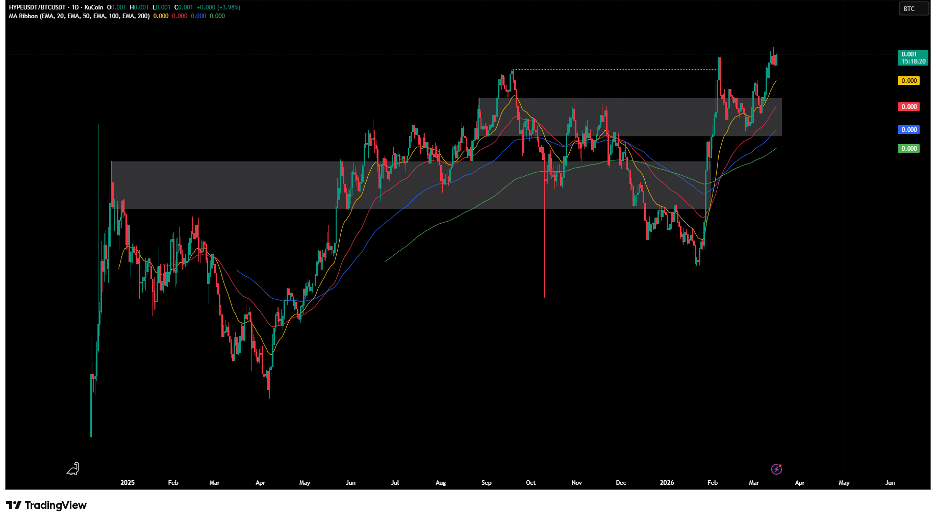
HYPE remains strong versus BTC as it relatively continues to create higher highs after testing the resistance turned support.
This strength can be attributed to the rollout of Hyperliquid's tradfi markets, particularly equities, oil and gold derivatives, allowing the protocol to generate meaningful trading fees from the volatility of these assets. 97% of Hyperliquid's revenues are used to buy and burn HYPE from the open market, giving the token an enduring bid.
Chartbook
Bitcoin (BTC)
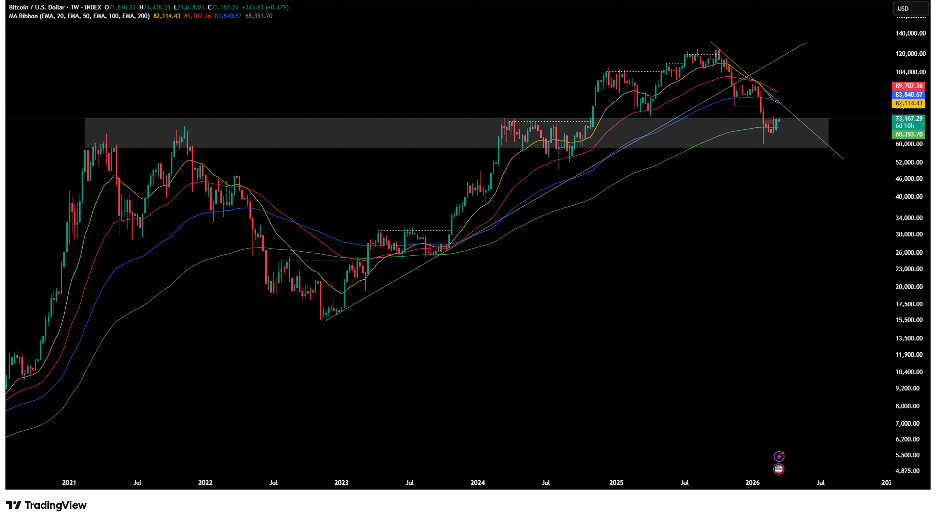
Bitcoin is still at the 200-week moving average and key $65,000–$70,000 psychological support zone. Further decline is expected if this previous resistance turned support zone does not hold. Possible reversal should price decisively break the downward sloping trendline.
Ethereum (ETH)
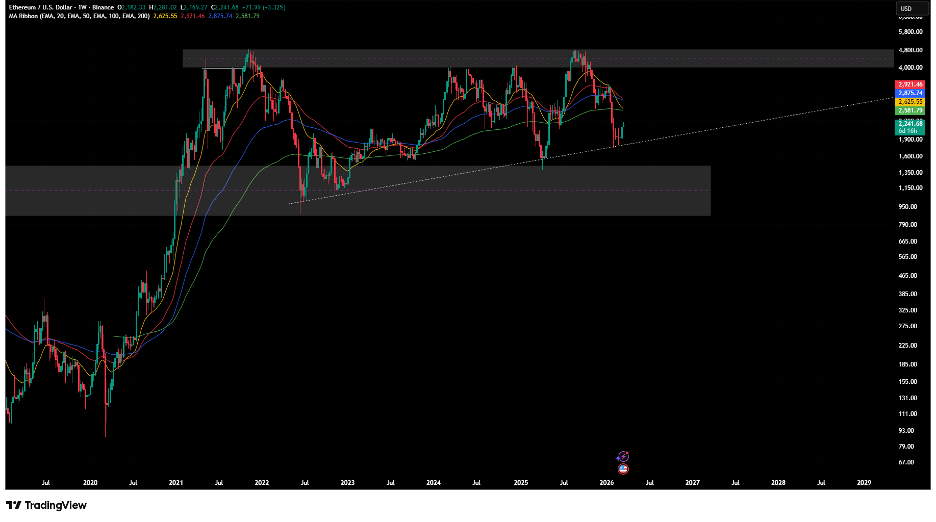
As of this writing, ETH seems to be respecting the ascending trendline support of the possible multi-year ascending triangle on the weekly timeframe. Should ETH hold the rising trendline support, the pattern remains intact and would set up a potential breakout toward new all-time highs over the medium term.
Solana (SOL)
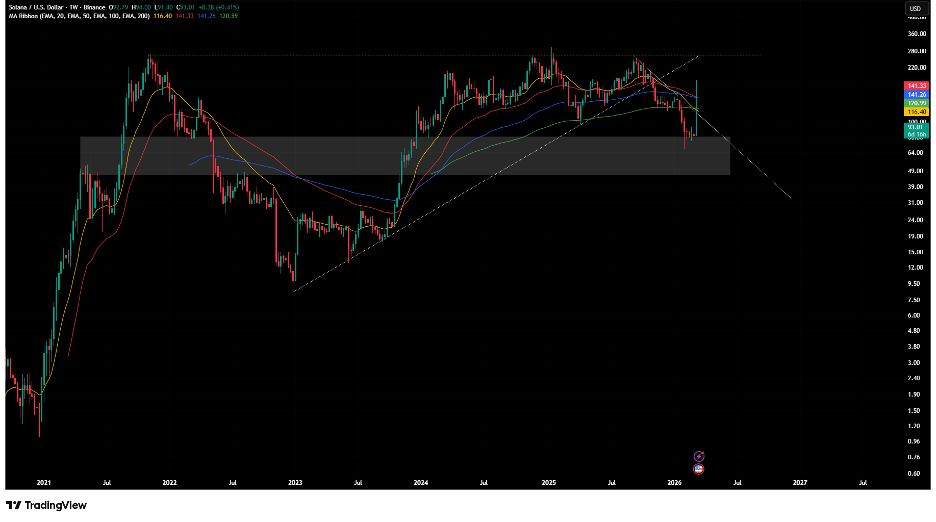
Strong reaction was observed at the current support zone, but failed to break the downward sloping trendline indicating bears are still in control of SOL.
Looking Ahead
March closes with several near-term catalysts on the horizon — the FOMC meeting on March 17–18, the SEC's March 27 deadline on 91 pending crypto ETF applications, and the CLARITY Act still in active Senate negotiation.
We remain cautious heading into April. The Iran conflict and its ongoing effects on oil prices continue to weigh on the macro backdrop, keeping the Fed on hold and risk appetite suppressed. A resolution to the conflict remains the single most important catalyst for an improvement in broader financial conditions — and by extension, for crypto. Until that materializes, we treat any price recovery with skepticism.
That said, we are not static in our thinking. We are continuously monitoring developments across all fronts — regulatory progress, geopolitical shifts, ETF flow data, and on-chain indicators — and we will evolve our positioning as the picture changes. The market is moving quickly, and so is our analysis of it.
At Anbruggen Capital, we are positioned defensively and preserving dry powder for what we believe will be a more compelling entry point ahead. Reach out at [email protected] to discuss our positioning.
Disclaimer: Investing in cryptocurrencies involves significant risk. Past performance does not guarantee future results. All opinions and scenario probabilities represent the views of Anbruggen Capital at the time of writing and are subject to change. Consult with a financial adviser before making investment decisions.