
Issue # 10 | May 2026
A Hawkish Pivot Meets a Re-escalating Conflict
Welcome to Crypto Pulse
This is the May 2026 edition of Anbruggen Capital Crypto Pulse.
The story of May is about a shift in what's being priced in by the market. Six weeks ago, rate desks were debating rate-cut frequency for 2026. Now, the same desks are talking about rate hikes. April CPI came in hot, April PPI came in shockingly hotter, and in the last few days oil has staged another rally as the Iran ceasefire frays. The macro narrative has flipped from "easing trajectory paused" to "tightening risk back on the table." The institutional groundwork for crypto, meanwhile, had a constructive month: Warsh confirmed as Fed Chair, the CLARITY Act confirmed by committee, and Charles Schwab opening spot crypto trading. We will talk about all these and more, in this Issue of the Crypto Pulse.
Contact us at [email protected] for more information.
Latest News
Kevin Warsh Confirmed as Fed Chair
- The Senate confirmed Warsh on May 13 by 54–45, the narrowest margin in modern Fed history. John Fetterman was the only Democrat to vote yes. Powell's term as Chair expired May 15.
- Powell will stay on as a Governor through January 2028, citing the ongoing investigation into Fed building renovations. Warsh takes the Board seat vacated by Stephen Miran.
- Warsh has publicly called for "regime change" at the Fed. His first FOMC as Chair is June 16–17.
Our Take: Warsh arrives wanting to cut, but the data he's looking at says he can't. Markets initially treated his confirmation as dovish; the CPI and PPI prints since then have neutralized that. How he handles the easing bias in the June statement will tell us more than anything he's said publicly.
April 29 FOMC — Most Divided Meeting Since 1992
- The committee held at 3.50–3.75% in an 8–4 split. Miran voted for an immediate 25 bp cut; three others voted to hold but dissented against retaining the easing bias. Four dissents is the most since October 1992.
- The statement cited "developments in the Middle East" as a major source of uncertainty and acknowledged elevated inflation tied to energy prices.
Our Take: Three policymakers actively pushing back against the easing language is a louder signal than the headline split implies. After the May data prints, those three look prescient. The bigger question is whether Warsh's first statement still contains an easing bias at all.
CLARITY Act Clears Senate Banking — 15–9
- The Senate Banking Committee advanced the Digital Asset Market CLARITY Act on May 14. The bill heads to the Senate floor with a realistic shot at passage before the November midterms.
- Key provisions: a "Mature Blockchain Test" codifying Bitcoin's commodity status in federal statute; equivalent treatment for Ethereum; Section 409 carving out DeFi developers who don't custody user funds; and automatic commodity classification for tokens with approved spot ETFs before January 1, 2026.
- Citi has tied its $143,000 BTC base case for 2026 directly to CLARITY passage, modeling $15 billion in incremental ETF inflows.
Our Take: The most significant US crypto legislation ever to clear a committee. Senate floor passage, House reconciliation with H.R. 3633, and a Presidential signature remain ahead within a tight pre-midterm calendar.
- Charles Schwab launched spot Bitcoin and Ethereum trading for retail clients on May 13. Schwab oversees more than $9 trillion in client assets.
- Cumulative net inflows across the spot Bitcoin ETF complex are now above $59 billion; IBIT alone holds more than $67 billion in AUM.
Our Take: Schwab's client base skews older and wealthier than the crypto-native venues — the cohort most chronically underweight crypto and best positioned to change that quickly now that the rails exist.
Global Macro View
In mid-March, the conversation on rates desks was about timing the first cut. The dominant view treated the Iran-driven energy shock as a supply-side disturbance that would pass through without embedding itself in core inflation. That framework has not survived the May data.
CPI for April printed 3.8% year-over-year. Core was sticky at 2.8%. The PPI a day later broke the prior narrative entirely: headline up 1.4% on the month against a 0.5% consensus — roughly three times the expected print and the largest monthly gain since March 2022. The annual reading jumped to 6.0%. Nearly 60% of the monthly increase came from services, which kills the "this is just oil passing through" story. Services inflation is the part of the basket the Fed actually targets with policy.
Fed funds futures now imply 40–50% odds of a rate hike by year-end. The 10-year touched 4.49% on the PPI release. Bank of America has pushed its first cut call out to the second half of 2027. And this is happening as oil climbs back above $100. The IEA's view that global crude markets may stay undersupplied through October — even if the war ended next month — sits uncomfortably with anyone modeling inflation back to target by year-end. If the May CPI print, due June 11, comes in above 4%, the discussion shifts from "when does the Fed start cutting" to "when does the Fed signal the next move could be a hike."
Bitcoin holding above $75,000 through all of this is, in context, is a respectable outcome. The asset absorbed a hot CPI, a much hotter PPI, oil rallying again, and a hawkish repricing of the rate curve, and it did not break down, at least not yet. Whether it holds if hike expectations harden further is the question for the weeks to come.
References:
- April Inflation Data (CPI & PPI): https://www.cnbc.com/2026/05/13/ppi-inflation-report-april-2026-.html
- Fed Rate Hike Probability: https://cryptobriefing.com/iran-tensions-drive-wti-crude-oil-surge-fed-rate-cut-odds-fall-for-2026/
- April 29 FOMC Statement: https://www.federalreserve.gov/newsevents/pressreleases/monetary20260429a.htm
- Iran Re-escalation:
https://www.cnbc.com/2026/05/12/oil-prices-today-brent-wti-trump-iran-war-hormuz.html
Crypto Spotlight
The CLARITY Act — Why It Matters for Crypto
The Senate Banking Committee's 15–9 vote on May 14 puts US crypto legislation closer to enactment than at any point in its multi-year history. The bipartisan margin matters — market structure is no longer purely a partisan fight — and Congressional leadership is pushing for passage before the November midterms.
For crypto, the bill is structurally bullish for three reasons:
- It removes regulatory tail risk
The "Mature Blockchain Test" writes Bitcoin and Ethereum's commodity status into federal statute, eliminating the threat of a future SEC trying to reclassify them as securities. Tokens with spot ETFs approved before January 1, 2026 (including SOL) inherit the same protection automatically.
- It protects on-chain infrastructure
Section 409 carves out DeFi developers who don't custody user funds from intermediary registration. This is the provision Coinbase cited when reversing its opposition to the bill in April, and it functionally shields the entire on-chain stack from being treated as money transmitters.
- It unlocks institutional capital
Citi models $15 billion in incremental ETF inflows on passage, additive to a complex already holding $96 billion in AUM. The bill creates a CFTC-pathway registration for exchanges and custodians with explicit KYC, sanctions, asset segregation, and conflict-of-interest requirements — the regulatory clarity that pension funds, endowments, and large allocators have been waiting for before deploying meaningful size.
Taken together, CLARITY would finalize the regulatory foundation the US crypto market has been missing for a decade. It hardwires the asset class into the institutional financial system, opens the door for the next wave of allocator capital, and meaningfully strengthens the structural case for the next cycle.
Chartbook
Bitcoin
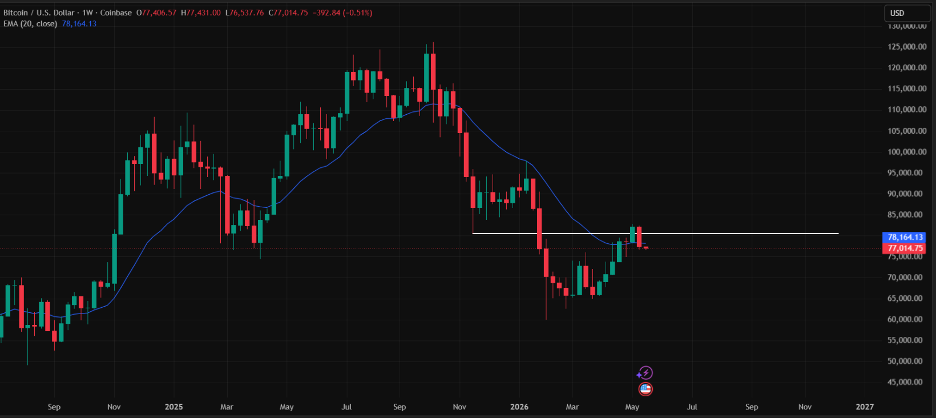
BTC made a weekly close below the pivotal $80,000 price point, as well as its 20-wk exponential moving average. BTC needs to reclaim these important levels for its bullish recovery to resume.
Ethereum
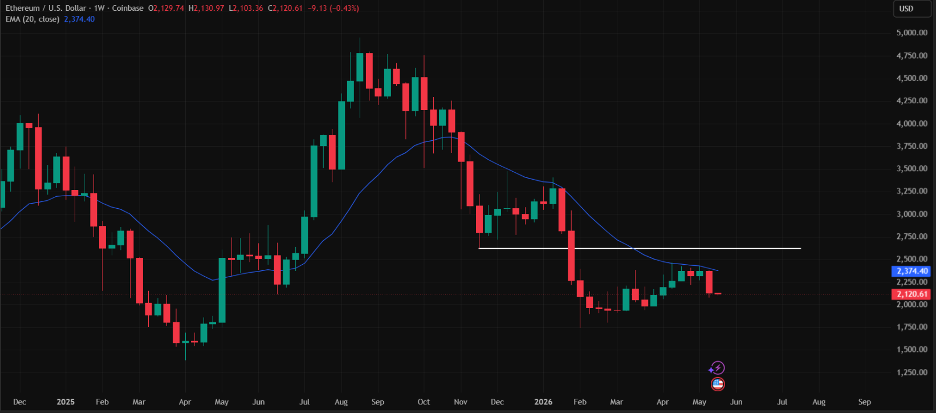
ETH looks weaker than BTC and was fully rejected at its 20-wk exponential moving average. ETH needs to trade around $2,750 for a convincing bullish reversal.
Looking Ahead
The coming weeks will be defined by how three open questions resolve: whether oil cools or climbs from here, whether Warsh's first statement on June 17 leans dovish or hawkish, and whether CLARITY clears the Senate floor before the midterm recess closes the window.
None of these is binary, and none might resolve cleanly, but the asymmetry is worth noting. The downside scenarios are well-telegraphed and largely already in the curve. The upside scenarios — a genuine ceasefire, a Warsh Fed that signals patience rather than tightening, CLARITY enacted into law — are not yet priced.
We remain defensively positioned and patient. The opportunity in a market like this is not in chasing the next move; it is in being ready when the picture clears. Reach out at [email protected] to discuss positioning.
Disclaimer: Investing in cryptocurrencies involves significant risk. Past performance does not guarantee future results. All opinions represent the views of Anbruggen Capital at the time of writing and are subject to change. Consult a financial adviser before making investment decisions.